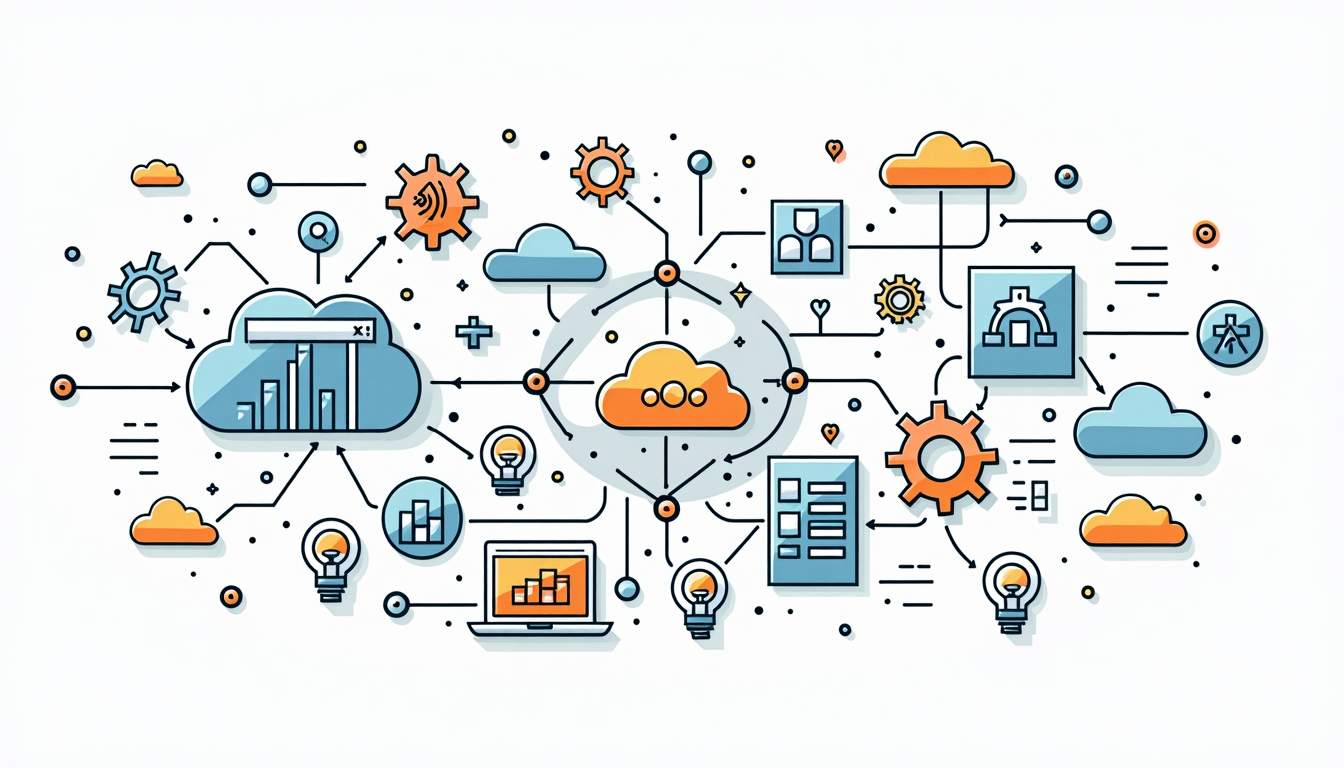

A product launch stalls because an integration to an old mainframe keeps failing. A security patch takes weeks because no one wants to touch a brittle legacy app. A new AI use case gets shelved because the data lives in systems no one fully understands. These are not edge cases anymore; they are daily symptoms of aging technology. No surprise that 80% of organizations say inadequate or outdated technology is holding back innovation. Modernization is no longer a side project for IT-it is the engine for agility, resilience, and growth.
Why IT Modernization Cannot Wait
Most organizations have already started some form of digital transformation, yet many still run critical processes on decades‑old platforms. One survey found that 94% of organizations worldwide are pursuing digital transformation in some form, but transformation stalls quickly when the foundation is fragile. Legacy systems increase risk, elevate operating costs, and slow down every new initiative that depends on them. Teams spend more time firefighting than innovating, and even simple changes require heroic effort.
Pressure is building from multiple directions. Customers expect seamless, digital‑first experiences. Regulators demand stronger security and transparency. And as Nutanix executive Lee Caswell notes, “Whether it be because of AI, sustainability, or security imperatives, IT organizations are facing ever-increasing pressure to modernize their IT infrastructure quickly.” Those who move decisively turn technology into a growth driver; those who wait treat it as a sunk cost. The gap between the two widens every quarter that core platforms remain untouched.
What IT Modernization Really Means
IT modernization is not just “moving to the cloud” or rewriting an old application. At its core, modernization is the deliberate transformation of technology, processes, and skills so the organization can respond faster to change, launch new products quickly, and operate with less risk. It is as much about how teams work and how decisions get made as it is about infrastructure or code.
Done well, modernization connects technology investments directly to business outcomes: faster time‑to‑market, better customer experiences, increased resilience, and new revenue streams. It creates a platform where experimentation is safe, integration is simple, and scaling is routine. That requires looking beyond isolated projects and treating modernization as an ongoing capability.
Core dimensions of modernization
Modernization spans several interlocking dimensions. Application modernization focuses on rehosting, refactoring, or replacing legacy systems so they become modular, API‑driven, and easier to evolve. Infrastructure modernization shifts from static, hardware‑centric environments to software‑defined, cloud or hybrid platforms that can scale up or down when the business needs it. Data modernization consolidates and cleans scattered data, making it accessible, governed, and ready for analytics and AI.
Operating‑model modernization changes how work gets done: adopting DevOps practices, automating releases and testing, and aligning cross‑functional teams around business outcomes instead of siloed functions. Security modernization embeds protection into every layer of the stack and every step of the development lifecycle, rather than bolting controls on at the end. Finally, experience modernization aligns internal tools and customer‑facing interfaces so people can actually use the capabilities the technology enables.
What IT modernization is not
Modernization is not a one‑time migration project that magically ends with a “modern” sticker on an old system. Simply lifting and shifting a monolithic application into the cloud without changing its architecture, dependencies, or operating model might lower some infrastructure costs, but it rarely delivers real agility or resilience. The same applies to buying a new SaaS product without integrating it into workflows or data streams.
It is also not a purely technical exercise divorced from strategy. When modernization is driven only by technology refresh cycles or vendor roadmaps, it often fails to deliver measurable business value. Treating modernization as a checklist-“Move database X, retire server Y”-misses the chance to reduce risk, differentiate in the market, and unlock new revenue. The goal is not just a new platform; the goal is a more adaptive and competitive organization.
A Practical Framework for IT Modernization
A clear framework turns modernization from a vague aspiration into a manageable program. While every organization is different, four phases tend to show up consistently: assess and prioritize, design the target state, execute in iterative waves, and then govern and optimize. Each phase has a distinct goal, but feedback flows between them so the approach can adapt as the business and technology landscape change.
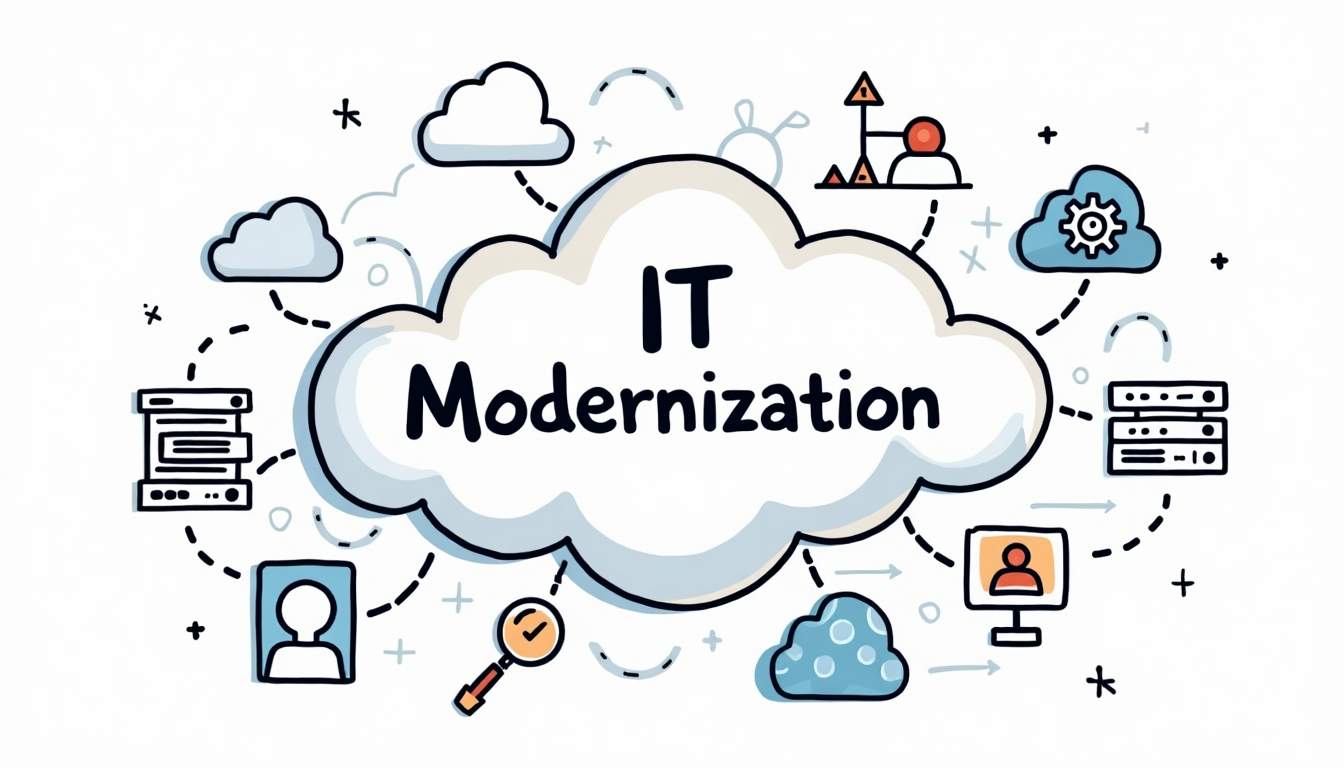
Phase 1: Assess and prioritize
The first step is to build a realistic picture of the current environment. That means inventorying applications, infrastructure, integrations, and data flows, but also mapping them to business capabilities and outcomes. Which systems truly differentiate the organization? Which processes are most critical for revenue, compliance, or customer experience? Which platforms pose the greatest operational or security risk?
With this view, modernization candidates can be ranked by impact and urgency. High‑value, high‑risk systems often warrant early attention, but low‑risk, high‑visibility wins are also useful for building momentum. The outcome of this phase should be a prioritized backlog of modernization initiatives, with clear business owners and measurable objectives for each.
Phase 2: Design the target state
Once priorities are set, the next job is to design a target architecture and operating model that support them. This design should describe how applications, data, and infrastructure will interact; which capabilities will live in the cloud, which stay on‑premises, and how hybrid scenarios will work. It should define integration patterns, security controls, and data governance models that scale as the business grows.
Equally important, this phase clarifies how teams will work in the new environment. What skills are required? How will responsibilities shift between infrastructure, application, and security teams? How will change management and governance evolve so they enable speed instead of blocking it? A good target‑state design is concrete enough to guide decisions, but flexible enough to adjust as learning occurs.
Phase 3: Execute in iterative waves
Modernization rarely succeeds as a giant, multi‑year, all‑or‑nothing program. Executing in waves reduces risk and lets teams learn quickly. Start with a few well‑chosen initiatives that are important enough to matter but contained enough to manage. Use agile delivery practices, frequent releases, and close partnership between business and IT stakeholders.
Each wave should include a clear migration or transformation plan, explicit rollback options, and defined success metrics. Lessons learned-about technology choices, team structures, or vendor performance-feed into the backlog and shape subsequent waves. Over time, the organization builds a repeatable playbook for different patterns: rehost, refactor, replatform, replace, or retire.
Phase 4: Govern, measure, and optimize
Without strong governance and measurement, modernization can drift into a loose collection of disconnected projects. Establish guardrails for architecture, security, data, and vendor selection so teams can move quickly within well‑defined boundaries. Standardized patterns and reference architectures prevent every team from solving the same problems from scratch.
Measurement closes the loop. Track metrics like time‑to‑market for new features, incident rates, deployment frequency, infrastructure utilization, and business KPIs tied to each modernization initiative. Use these insights to refine the roadmap, double down on approaches that work, and retire tools and processes that slow things down. Over time, continuous optimization becomes part of the culture, not a special project.
The Role of AI and Automation in Modernization
AI and automation are changing what is possible in IT modernization. Intelligent agents can now analyze codebases, suggest refactoring patterns, and automate portions of testing and deployment. McKinsey research describes AI agents delivering a 40 to 50 percent acceleration in tech modernization timelines and a 40 percent reduction in costs tied to technology debt, when deployed in well‑managed programs. That kind of impact reshapes the economics of tackling long‑ignored legacy estates.
AI is also beginning to tackle highly specialized tasks such as language and platform migration. One study on AI-driven modernization of legacy COBOL code into Java reported 93% accuracy, with significant reductions in code complexity and coupling compared with manual or rule‑based approaches. These tools do not eliminate the need for architects, engineers, or rigorous testing, but they can dramatically compress timelines and free skilled people to focus on design and value, rather than rote translation. The key is to treat AI as a force multiplier within a governed framework, not as a shortcut that bypasses architecture, security, or quality controls.
Building the Business Case for Modernization
Securing funding for modernization requires a narrative that connects technology changes to growth, resilience, and strategic differentiation. Direct cost savings-such as retiring expensive data centers or reducing software maintenance fees-are part of the story, but rarely the most compelling part. Faster product launches, improved customer satisfaction, reduced downtime, and lower cyber risk typically have more substantial long‑term value, even if they are harder to quantify.
The market signals are strong. The global IT modernization service market is projected to grow from US$ 30.73 billion in 2024 to US$ 64.71 billion by 2031, at a CAGR of 11.38%. Organizations are not investing at that scale merely to “catch up” technologically; they are betting that modern platforms will let them adapt faster than competitors. When building a business case, tie each modernization initiative to specific revenue opportunities, cost‑avoidance scenarios, or risk reductions, and align them with strategic themes the board and executive team already care about.
IT Modernization as a Continuous Capability
Modernization is increasingly recognized as a core competency, not a one‑off program. A recent survey found that 87% of business leaders see modernizing critical applications as a key success driver, with competitive advantage as the leading reason to invest. That mindset shift is crucial: when modern platforms are treated as strategic assets, they receive the continuous care, funding, and executive attention required to keep them healthy.
For organizations looking to start or accelerate their journey, the most effective move is often a focused 90‑day campaign: assess a slice of the portfolio, design a realistic target state, execute one or two high‑impact modernization waves, and put simple metrics in place. Use the results-good and bad-to refine the approach and scale it. Over time, this cycle becomes part of how the organization operates. Technology debt shrinks, options expand, and the business gains the agility to pursue new ideas as soon as they emerge, rather than waiting for the legacy stack to catch up.
Stop Planning, Start Shipping with Control
We know. Frameworks and AI tools are powerful, but taking the first step is often where modernization stalls. Internal teams are frequently too buried in daily operations to execute the initial, high-risk pilot. This is the specific operational gap addressed by Control.
Instead of committing to a massive, multi-year program from day one, Control deploys a specialized, AI-native team to solve a single, critical engineering blocker. Whether it’s refactoring a brittle module or proving a new cloud pattern, we fix one hard problem at a fixed price. This proves the value of modernization in your real environment, giving you the momentum to scale the rest of your strategy with confidence.