
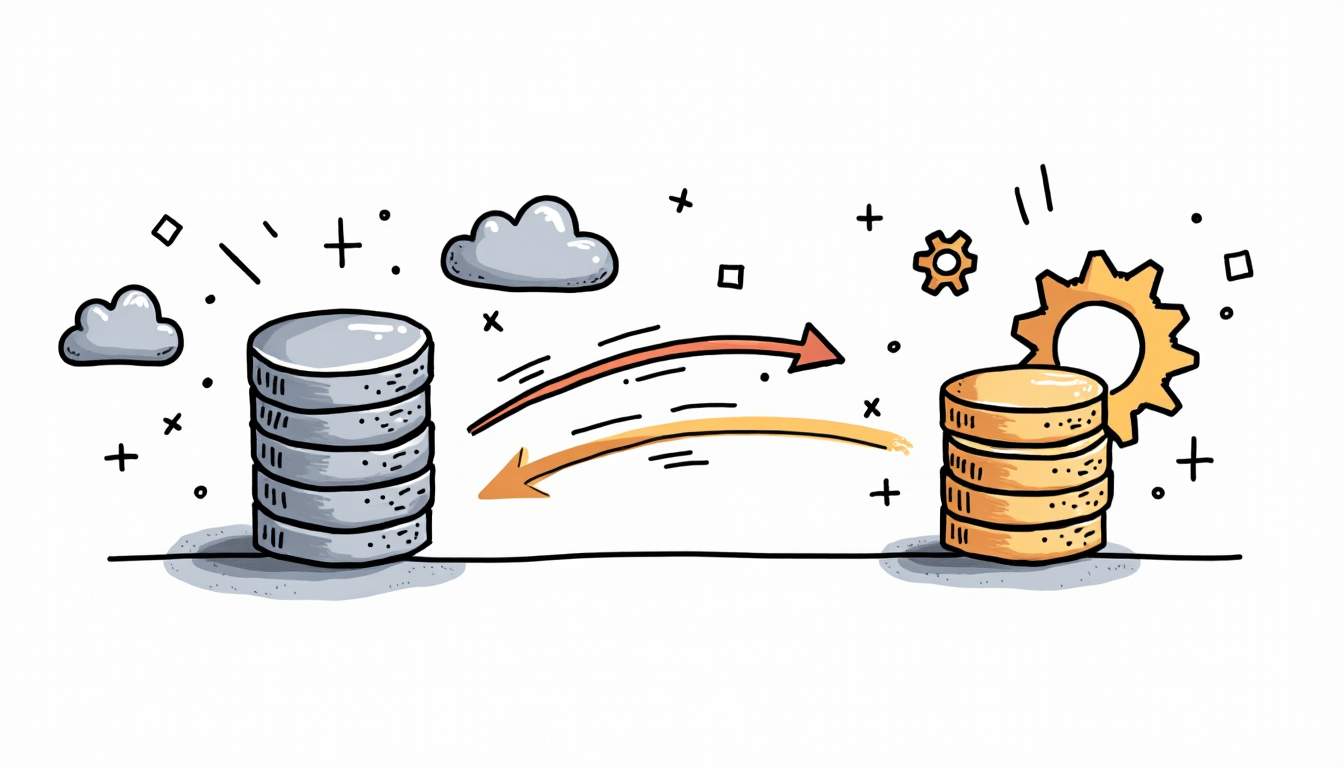
Ask anyone who has lived through a major database migration what it felt like, and the answer usually includes long nights, unexpected fires, and a launch date that kept slipping to the right. That reputation is not just folklore. A 2023 study by Prescience Data Solutions found that 67% of enterprise migration projects experience significant delays, running on average 4.7 months longer than planned. Those extra months often mean real money, real risk, and real strain on teams.
Yet companies still have to move data. Legacy databases reach their limits. Licensing costs climb. New analytics platforms promise capabilities the old systems can’t match. Ignoring the need to migrate is usually more dangerous than tackling it head-on. The real challenge is learning how to approach migration with discipline, realism, and a strategy that balances risk with opportunity.
This article breaks database migration into three practical questions: why it’s so risky, what core principles guide a successful move, and which strategies and patterns actually work. It then looks closely at the most common challenges and how to prepare for them, so a migration becomes a controlled, measurable initiative instead of a career-defining crisis.
Why Database Migrations Are So Risky
Database migrations combine three things executives dislike: uncertainty, limited visibility, and direct impact on revenue-critical systems. Analysts have been warning for years that DBMS migrations routinely take longer and cost more than expected, with some initiatives never fully delivering what was promised. That pattern comes from the nature of these projects: they touch data models, applications, integrations, reporting, security, and operations all at once.

Steve McDowell, Chief Analyst and CEO of NAND Research, described it bluntly: “There is no IT project more dreaded and risky than a data migration project.” His view, shared in a Forbes analysis of migration challenges, reflects what many architects and DBAs already know: a migration is not just a technical cutover but an organizational stress test that exposes every hidden dependency and short-cut that accumulated over years. The Forbes piece on overcoming data migration challenges highlights how these projects blend technical and business risk in ways few teams fully appreciate at the outset.
Risk shows up in several dimensions at once:
- Technical risk: schema differences, incompatible data types, performance regressions, and untested query plans.
- Operational risk: extended downtime, complex rollback scenarios, and pressure from fixed launch dates.
- Business risk: lost transactions, inaccurate reports, compliance exposure, and frustrated customers or partners.
- Human risk: overloaded subject-matter experts, gaps in institutional knowledge, and misaligned expectations between IT and business stakeholders.
Understanding this risk profile is the first step. The point is not to avoid risk altogether, which is impossible, but to design the migration so that risk is surfaced early, contained, and managed deliberately instead of discovered during a 3 a.m. cutover window.
Core Principles of Successful Database Migration
Every successful migration looks different on the surface-different tools, platforms, timelines, and technologies. Underneath, the same set of principles usually shows up. These principles help teams make consistent decisions when trade-offs appear, which they will.
Thinking in terms of principles rather than tools also protects organizations from “tool-first” planning. A shiny new migration utility or replication engine might be useful, but without clarity on what matters most-data quality, business continuity, security, performance-it is easy to automate the wrong things or optimize for the wrong outcomes.
Principle 1: Clarity of Outcomes Before Technology Choices
Before any schemas are analyzed or ETL pipelines drawn, the team needs a shared understanding of why the migration is happening. Is the main driver cost reduction, performance, regulatory compliance, new analytics capabilities, vendor risk, or something else? The answer shapes everything from acceptance criteria to cutover strategy.
Clear outcomes translate into measurable success metrics. For example, “modernize the database” is vague. “Reduce average query latency for critical reports by half, while meeting existing SLAs and preserving historical reporting accuracy” is concrete. That level of clarity makes it much easier to decide whether a risky optimization is worth it, or whether a scope expansion belongs in a later phase.
Principle 2: Treat Data Quality as a First-Class Requirement
Migrations tempt teams to assume that existing data is “good enough,” because inspecting and cleaning it takes time and budget. That shortcut is expensive. A Gartner report on data quality estimates that poor data quality costs organizations an average of $12.9 million annually. During a migration, those costs can spike as inconsistencies or corrupt data propagate into the new environment and then into downstream systems.
Data profiling, validation rules, and reconciliation processes belong in the migration plan, not as optional add-ons. That includes decisions about how to handle duplicates, malformed values, orphaned records, and conflicting business rules that evolved organically over time. Teams that invest in data quality as early as possible find that the migration becomes an opportunity to fix long-standing issues instead of entrenching them in a new platform.
Principle 3: Minimize Risk, Not Just Downtime
It is tempting to frame the migration primarily around downtime, especially for customer-facing systems. But the real goal is broader: minimize overall risk. That can mean tolerating a slightly longer maintenance window in exchange for a simpler, more reversible cutover design, or phasing non-critical workloads into later waves.
Risk-based thinking also pushes teams toward realistic rollback strategies, comprehensive testing in production-like environments, and incremental rehearsal of key steps. When every major activity has a tested, time-bounded rollback plan, executives sleep better and teams are more willing to surface issues early instead of quietly hoping for the best.
Migration Strategies: Choosing the Right Path
Once goals and principles are clear, the next decision is how to actually execute the move. Migration strategies sit on a spectrum from “all at once” to “slow and gradual,” with hybrids in between. The right answer depends on system criticality, integration complexity, tolerance for change, and the team’s operational maturity.
Performance is a key dimension that is often underestimated. A study published in the International Journal of Advanced Research in Computer Science and Technology reported that organizations using machine learning models for workload characterization and performance prediction achieved average post-migration query optimization improvements of 43.7%, with 22% of applications seeing performance gains above 200%. That kind of uplift does not happen by accident; it comes from understanding workloads in detail and baking performance thinking into the chosen strategy.
Big-Bang Migration
In a big-bang approach, the entire database-or at least a major logical unit-is migrated in a single event. The old system is taken offline, data is moved and transformed, smoke tests are run, and traffic is cut over to the new environment. This pattern minimizes the duration of dual-running systems and avoids prolonged complexity in integration, but it amplifies risk. If something goes wrong, the blast radius is large, and rollback can be painful. Big-bang is best when the system is relatively self-contained, the data model is well understood, and the business can tolerate a carefully planned outage.
Phased or Wave-Based Migration
A phased strategy breaks the migration into logical slices: by business domain, customer segment, geography, or application. Each wave is treated as a small project with its own readiness criteria, testing, and cutover. This reduces risk and allows lessons learned from early waves to improve later ones. The trade-off is operational complexity while both old and new systems run side by side, and the need to manage cross-system consistency carefully when data spans multiple domains.
Parallel / Hybrid Migration
Parallel migrations keep old and new systems running concurrently for a period, with a mix of data replication, dual writes, or feature toggles to control traffic flows. Some organizations apply a “strangler-fig” pattern: migrating specific capabilities or services to the new database while leaving others on the legacy platform until they are replaced. This approach provides rich opportunities for verification-comparing outputs from both systems under real workloads-but demands mature monitoring, observability, and operational discipline to manage the added moving parts.
Common Challenges and How to Address Them
Even with sound principles and a sensible strategy, migrations face a predictable set of obstacles. A 2024 study in the International Journal of Novel Research and Development identified data quality, system compatibility, integration complexity, and data security as key challenges in data migration projects. Treating these as known constraints rather than surprises allows teams to plan mitigation steps explicitly.
Most failed or painful migrations can be traced back to some combination of four themes: messy data, underestimated dependencies, optimistic timelines around downtime, and security or compliance gaps. Each has practical countermeasures, but they need ownership and time.
Challenge 1: Data Quality Gaps
Hidden data issues surface quickly when schemas change or stricter constraints are introduced. Inconsistent date formats, free-text fields masquerading as structured data, and mismatched reference values all create friction. Addressing this requires systematic data profiling, clear remediation rules, and automated validation checks. Building reconciliation reports-before and after record counts by domain, control totals, and sampled record comparisons-gives stakeholders confidence that data has not been lost or corrupted in transit.
Challenge 2: System Compatibility and Integration Complexity
Databases rarely live in isolation. Applications, reporting tools, ETL jobs, batch processes, and downstream APIs all interact with them. When a migration changes data types, indexing strategies, or even subtle semantics, those integrations can break. A robust migration plan includes a dependency map, versioned interface contracts, and a strategy for coordinating changes across systems. Where possible, introducing abstraction layers-such as views, APIs, or data services-reduces tight coupling and makes migrations less disruptive.
Challenge 3: Downtime and Business Disruption
Every stakeholder wants “zero downtime,” but that phrase often hides the real question: what level of disruption is acceptable for which users, and for how long? For some internal systems, a scheduled overnight outage with clear communication is acceptable. For 24/7 transactional platforms, the bar is much higher. Techniques such as online schema changes, continuous replication with controlled cutover, and careful scheduling around low-traffic windows can all help. The critical piece is aligning expectations early and rehearsing the cutover steps until they are predictable.
Challenge 4: Security and Compliance
During migration, data often passes through temporary storage, staging tables, or intermediate environments. Each hop is a potential exposure point. At the same time, roles and privileges need to be mapped to the new system, which can lead to either over-permissioning (to “keep things moving”) or accidental lockouts. Including security and compliance teams from the start, encrypting data in transit and at rest, and auditing temporary access granted for the migration window all reduce risk. Logging and monitoring should explicitly cover migration activities so that any anomaly is detectable and traceable.
Building a Future-Proof Migration Practice
The most effective organizations treat each migration as both a delivery project and a learning opportunity. Over time, they build a repeatable practice: common patterns, playbooks, checklists, and tools that make the next move easier than the last. Governance and access control are a big part of this maturity. A 2025 study highlighted by ISACA showed that organizations implementing role-based access control (RBAC) saw a 30% reduction in unauthorized access incidents during data migration, as reported in an analysis of top migration challenges covering data migration risk and RBAC effectiveness. Structured access is not just good security; it simplifies who can do what during high-pressure change windows.
Future-proofing is less about predicting specific technologies and more about investing in capabilities that translate across platforms: observability, automation, standardized data contracts, and healthy collaboration between engineering, operations, and business stakeholders. Teams that normalize practices like migration runbooks, dry runs, and blameless post-mortems find that even when surprises occur, they are managed rather than chaotic.
Habits of Teams That Migrate Well
Certain habits show up again and again in organizations that handle migrations with relatively low drama. These habits are cultural as much as technical, and they make each subsequent move less risky than the last.
Common patterns include:
- Early, honest risk assessment: surfacing uncomfortable truths about data quality, dependencies, and resource constraints while there is still time to adjust scope.
- Iterative rehearsal: running multiple non-production and limited-scope production rehearsals of key migration steps, with careful timing and detailed logging.
- Strong observability: metrics, logs, and traces that clearly show application behavior, query performance, and user impact before, during, and after cutover.
- Deliberate knowledge sharing: documenting schemas, migration decisions, and learned lessons in a way that new team members can understand months or years later.
- Real partnership with the business: aligning schedules, acceptance criteria, and communication plans so users know what to expect and how to escalate issues.
Database migrations will probably never feel trivial. They involve moving the crown jewels of the organization while keeping the business running and stakeholders calm. Yet with the right principles, strategies, and habits, they can shift from “dreaded and risky” to “demanding but manageable.” Each successful migration not only upgrades technology but also strengthens the organization’s ability to change, adapt, and grow with far less disruption the next time around.
Breaking the Migration Paralysis: How to Start
Knowing the principles of a safe migration is different from having the capacity to execute one. Internal teams are often too buried in daily operations to manage the intricate planning, rehearsals, and data cleaning required for a zero-surprise cutover. This is the specific operational gap addressed by Control.
Instead of risking a high-stakes "big bang" led by an overloaded team, Control deploys a specialized, AI-native squad to execute a specific, high-risk slice of your migration. Whether it’s moving a critical schema, untangling complex dependencies, or validating data quality at scale, we fix one hard problem at a fixed price—giving you a proven pattern and the confidence to migrate the rest of your estate safely.