I have watched funded founders spend $200,000 in four months building a product nobody wanted. The pattern is always the same: they raised a round, hired a dev shop immediately, and treated code output as progress. By the time they showed the product to real users, half their runway was gone and the market was telling them they built the wrong thing. If you are a non-technical founder trying to figure out how to build a startup app without a technical co-founder, the stakes are real. Your runway is finite. Every month you spend building in the wrong direction is a month you cannot get back. The good news is that you do not need a technical co-founder to build a strong product. You need a system that protects your capital while accelerating your learning.
How to build a startup app without a technical co-founder is the process of taking a product from concept to market using external development resources, no-code tools, and structured validation methods instead of relying on an in-house technical co-founder. Founders who follow a validation-first approach conserve runway and reach product-market fit faster than those who start coding on day one.

Building an app without a tech co-founder: a founder's desk with a product wireframe and validation loop.
TL;DR: Non-technical founders can build successful products without a technical co-founder by validating with real customers before writing code, choosing a build approach matched to their stage, selecting development partners who challenge assumptions rather than just execute, and structuring engagements around business outcomes instead of billable hours. The founders who fail skip validation and treat development speed as the primary risk. The founders who succeed treat building the wrong thing as the primary risk.
Why most non-technical founders burn runway before writing a line of code
The most expensive mistake I see non-technical founders make is not a bad tech stack or a slow developer. It is building something the market does not want. CB Insights analyzed over 100 startup failures and found that the number one reason startups fail is a lack of market need, cited in 35 percent of cases. That is not a technology problem. That is a validation problem.
In my experience, the founders who burn through capital fastest are the ones who treat fundraising as the starting gun for development. They close a round, hire a team within weeks, and start building features based on their own assumptions. Six months later, they have a polished product and zero traction.
The founders who make their capital work are the ones who treat validation as an ongoing discipline, not a one-time checkbox. Before a single sprint begins, they are talking to potential customers, running small experiments, and testing whether the problem they think they are solving actually exists. FI recommends that non-technical founders focus on customer discovery and market research before committing to any build approach. I could not agree more.
The validation phase does not require a technical co-founder. It requires discipline. Talk to 30 to 50 potential customers. Map their current workflows. Understand where they feel pain and what they are already paying to solve it. If you cannot find 10 people who express genuine urgency about the problem, you are not ready to build.
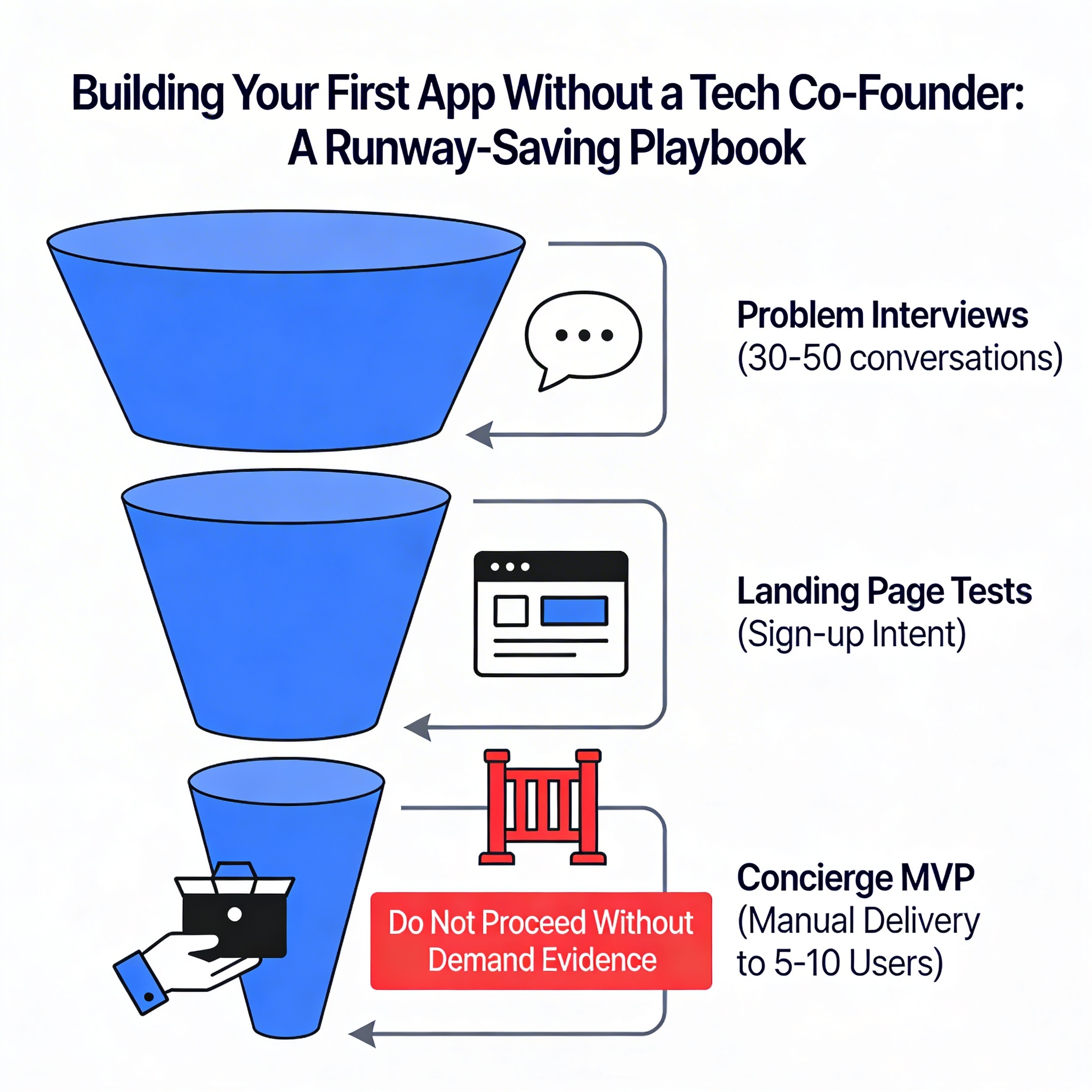
Choosing the right build approach for your stage
The right build approach depends on how much validation you have completed and what you need to learn next, not on what looks most impressive in a pitch deck.
I have worked with founders at every stage, from napkin sketch to Series A, and the ones who conserve capital match their build method to their learning goal. If you are still testing whether anyone wants your product, a no-code prototype gets you to user feedback in days, not months. Tools like Bubble, Webflow, and Glide let you ship a functional product without writing code. Theanna highlights no-code platforms as a practical starting point for non-technical founders who need speed over customization.
If no-code cannot handle your core logic, a focused development sprint with a small team is the next step. The key word is focused. Do not try to build your entire vision in the first engagement. Build the smallest thing that tests your riskiest assumption.
How to choose a development partner who protects your runway
The right development partner challenges your assumptions, proposes cheaper ways to validate, and measures success by business outcomes, not lines of code.
This is where most non-technical founders get stuck. Without a technical background, how do you evaluate whether a developer or agency is actually good? The instinct is to ask about their tech stack, their process, or their portfolio. Those things matter, but they are not the most important signal.
The most important signal is whether the partner asks you hard questions about your market before talking about their capabilities. In my experience, the best development partners act more like product thinkers than code factories. They ask who your customer is, what evidence you have that the problem is real, and what the cheapest way to test your core assumption would be. Jetrockets advises non-technical founders to prioritize partners who demonstrate business understanding, not just technical skill.
I have seen the opposite pattern too many times. A founder hires an agency that says yes to everything. Every feature is feasible. Every timeline is reasonable. The invoice is predictable. The product is expensive and misaligned, because nobody in the room was empowered to say this feature does not matter yet.
Structuring your engagement to maximize learning per dollar
Outcome-based sprints protect non-technical founders by tying every development dollar to a measurable business result, not to hours logged or tasks completed.
Even after choosing the right partner, the engagement structure determines whether your capital produces learning or waste. I have seen three common models, and only one consistently works for early-stage founders without technical co-founders.
The first is time and materials. You pay an hourly rate, and the team works on whatever you direct. This model puts all the risk on you. If the product does not resonate with users, you still paid for every hour. There is no accountability for outcomes.
The second is fixed scope. You define a detailed specification, and the team builds exactly that for a fixed price. This sounds safe, but it assumes you know what to build. For early-stage products, you almost never do. Rocketech notes that rigid scope agreements often lead to wasted development when market feedback demands a pivot.
The third model, and the one I have seen produce the best outcomes, is outcome-based sprints. You define a business objective, such as getting 50 users through onboarding, and the team owns delivering that outcome within a fixed timeframe and budget. If the outcome is not met, the risk is shared. This model works because it forces clarity about what matters, holds the partner accountable for results, and creates natural checkpoints to adjust direction.
What separates founders who ship from founders who stall
The founders who ship products users actually adopt are the ones who stay close to customers throughout development, not just during initial validation.
Across the engagements I have been part of at Wednesday, the pattern is clear. The founders who make progress share three habits that have nothing to do with technical ability.
First, they talk to users every week, not just during the validation phase. Development sprints produce artifacts. Those artifacts need to be tested with real people. The founders who treat user feedback as a continuous input, not a one-time event, catch misalignments early when they are cheap to fix.
Second, they make decisions fast. When a sprint reveals that a feature is not resonating, they cut it. They do not convene a committee or wait for more data. They trust the signal and redirect. Experienced founders on Quora consistently emphasize that decision speed, not technical skill, is the primary advantage non-technical founders need to develop.
Third, they keep their scope brutally small. The temptation is always to add one more feature before launch. The founders who resist that temptation get to market faster, learn faster, and iterate faster. Every feature you add to version one is a bet you are making without data. Make fewer bets, and make them count.
One of the most empowering shifts for non-technical founders has been the rise of no-code and low-code platforms, which allow you to build functional prototypes and even full-fledged applications without writing a single line of traditional code. Tools like Bubble, Adalo, and Webflow enable you to design user interfaces, set up databases, and integrate APIs through visual drag-and-drop interfaces, dramatically lowering the barrier to entry. For instance, you can use Airtable as a backend combined with a frontend tool like Softr to create a marketplace MVP in days, not months. This approach lets you validate core assumptions—such as user sign-up flows or payment processing—before committing to custom development. However, it's crucial to understand the limitations: no-code solutions may not scale efficiently for complex features or high traffic, so they're best used for early validation and learning. By starting here, you can gather real user data, refine your value proposition, and create a tangible prototype that speaks louder than any slide deck when pitching to developers or investors. This hands-on experimentation not only saves capital but also deepens your product intuition, ensuring that when you do invest in custom code, it's directed toward features with proven demand.
When it's time to move beyond prototypes, outsourcing development becomes a viable path, but it requires careful strategy to avoid common pitfalls like miscommunication, scope creep, or subpar code quality. Begin by defining a clear product requirements document (PRD) that outlines user stories, acceptance criteria, and technical specifications—this serves as a blueprint for developers and minimizes ambiguity. Platforms like Toptal, Upwork, or Clutch can connect you with freelance developers or agencies, but vet them rigorously: review portfolios, check references, and conduct technical interviews or trial projects. For example, you might hire a freelancer to build a specific module, such as user authentication, and assess their work before committing to a larger engagement. To manage the project effectively, adopt agile methodologies with two-week sprints, regular stand-ups, and tools like Jira or Trello for tracking progress. Budgeting is another critical aspect; consider fixed-price contracts for well-defined scopes or time-and-materials models for evolving projects, and always allocate a contingency fund for unexpected changes. Remember, your role shifts from coder to product manager—focus on clear communication, prioritize features based on validated learning, and ensure that every deliverable aligns with your business outcomes. This disciplined approach turns outsourcing from a risky gamble into a strategic lever for growth.
Beyond tools and outsourcing, building a sustainable app without a technical co-founder hinges on cultivating a feedback-driven culture that continuously integrates user insights into development cycles. Implement structured user testing early and often: use services like UserTesting.com or Lookback to conduct remote sessions where real users interact with your prototypes, revealing pain points and opportunities you might have missed. Combine this with analytics tools like Mixpanel or Hotjar to track behavioral data, such as drop-off rates in onboarding flows, which can inform iterative improvements. For instance, if data shows users abandoning a checkout process, you can prioritize simplifying that step in the next sprint. Additionally, foster a community of early adopters through beta programs or waitlists, engaging them via surveys or interviews to co-create features. This not only validates demand but also builds advocacy and loyalty. As you scale, consider hiring a product manager or growth hacker to oversee this loop, ensuring that development resources are always allocated to high-impact areas. Ultimately, success in this journey isn't about avoiding technical work altogether but about orchestrating it intelligently—leveraging external expertise, data, and user empathy to build something people truly want, all while maintaining the agility to pivot as you learn.
Real-world example: How a non-technical healthtech founder reached PMF in 6 months
A first-time founder with a clinical background raised a $1.8M seed round to build a patient engagement platform for chronic care management. She had deep domain expertise but no technical co-founder and no software development experience. Her initial plan was to hire a full-stack agency and build a comprehensive platform covering patient onboarding, care plan management, messaging, and analytics.
During our first conversation, I asked her a simple question: which of those four modules is the one that, if it fails, kills the entire product? She said patient onboarding. If patients did not complete the onboarding flow, nothing else mattered. We agreed to test that assumption before building anything.
She ran 40 patient interviews over three weeks. The feedback revealed that patients did not struggle with onboarding itself. They struggled with understanding why the platform was worth their time at all. The real problem was value communication, not UI friction.
Based on that insight, we restructured the build plan. Instead of a comprehensive platform, the first sprint focused on a single outcome: getting patients to complete a care assessment and receive a personalized care summary. We built that in a four-week sprint using a lightweight stack. The onboarding flow was three screens. The care summary was generated from a simple rule engine.
She tested it with 60 patients. 73 percent completed the full flow, compared to an industry average of 40 percent for chronic care platforms. More importantly, 28 percent scheduled a follow-up appointment through the platform, which was the monetization trigger.
Over the next three sprints, she iterated on messaging, added a basic messaging feature, and built provider dashboards. Within six months, she had 1,200 active patients and a signed pilot with a regional health system. Her total development spend was under $120,000, less than what she had budgeted for the first phase of the agency proposal.
The difference was not the technology. It was the sequencing. She validated before she built. She started with the riskiest assumption. She measured outcomes, not output.
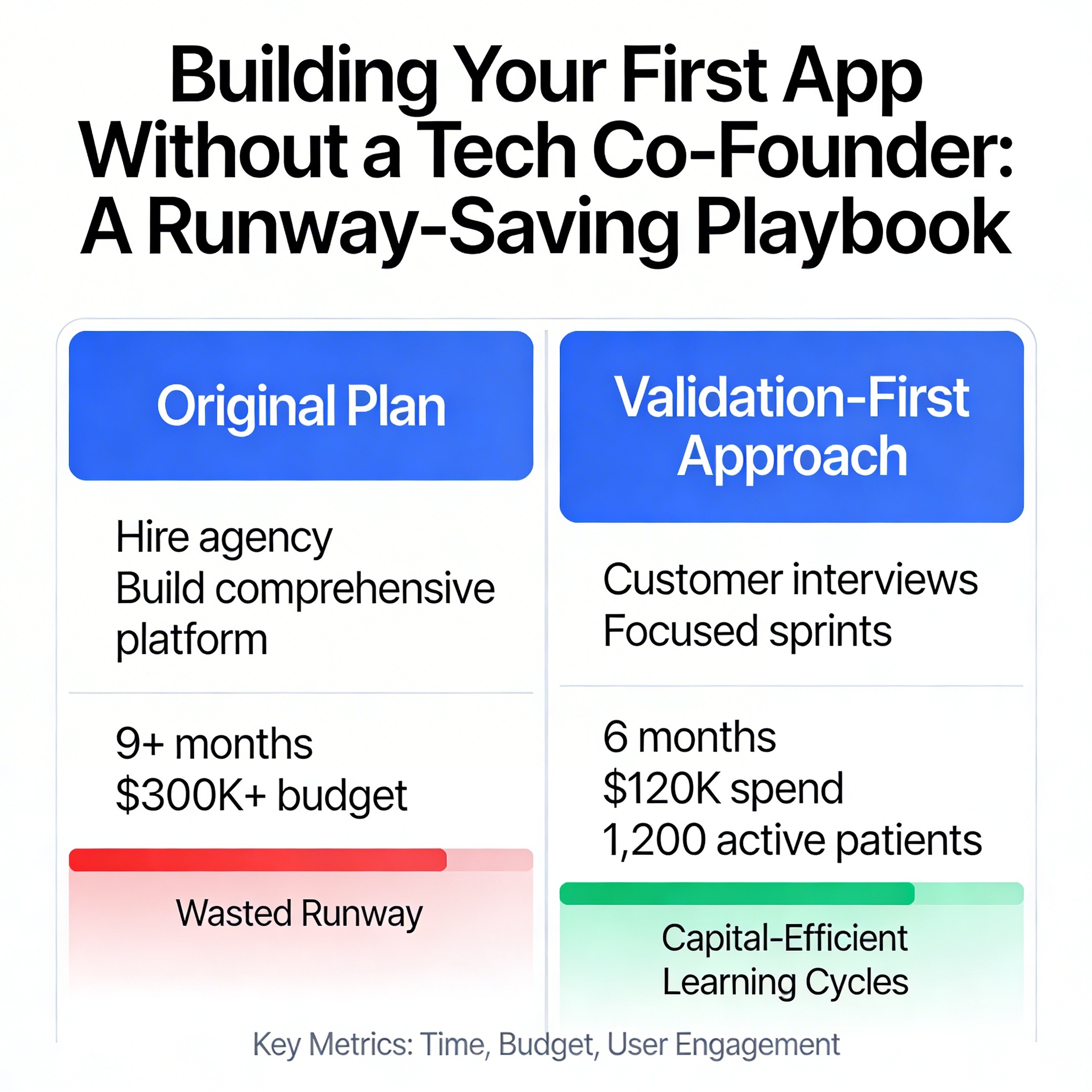
You do not need a technical co-founder to build a product that reaches market. What you need is a validation-first discipline that treats building the wrong thing as the primary risk, not building too slowly. The playbook is straightforward: validate with real customers before committing to code, choose a build method matched to your current stage, evaluate partners on their product thinking rather than their tech stack, and structure every engagement around measurable business outcomes.
The founders who move fastest are not the ones who write the most code. They are the ones who learn the most per dollar spent. If you are a funded founder navigating how to build a startup app without a technical co-founder, the core of how we approach early-stage product work at Wednesday is built on exactly this principle, validate first, build only what the evidence supports, and measure success by outcomes, not output.
FAQs
How do I validate my startup idea before writing any code?
Start by talking to 30-50 potential customers. Map their current workflows and pinpoint where they feel real pain. If you can't find at least 10 people who express genuine urgency about the problem, you're not ready to build. Validation is about confirming market need, not perfecting your pitch.
What are the best no-code platforms for building a mobile app?
For non-technical founders validating demand, Bubble, Webflow, and Glide are strong starting points. They let you ship a functional product in days, not months. Use them to test core assumptions with real users before committing to custom code. They're tools for learning, not for building your final, scalable product.
When should a startup founder choose no-code versus custom development?
Choose no-code when you're still testing whether anyone wants your product. It's faster and cheaper for learning. Move to custom development, like a focused sprint, when no-code can't handle your core logic or you've validated demand and need to build something more robust and scalable for your next growth phase.
Last updated: March 19, 2026